Adaptable infrastructure for resilient urban communities.
The Circl approach
Shared resources. Future-ready districts.
Modular energy and water infrastructure for urban districts and business parks — with optional capacity, energy trading and flexibility services.
Every solution is based on modular, technology-agnostic resource infrastructure — designed for long-term performance and adaptability.
The challenge
Enable urban development and business growth with adaptable, shared resource infrastructure.
Urban developments and business parks increasingly face grid congestion, growing demand and pressure on water infrastructure. Circl designs modular resource systems for buildings and shared facilities, combining local generation, storage, circular water solutions and intelligent controls. On business parks, optional collective capacity and flexibility services can add an operational layer where suitable.
The Circl approach
Local by design. Adaptable by nature.
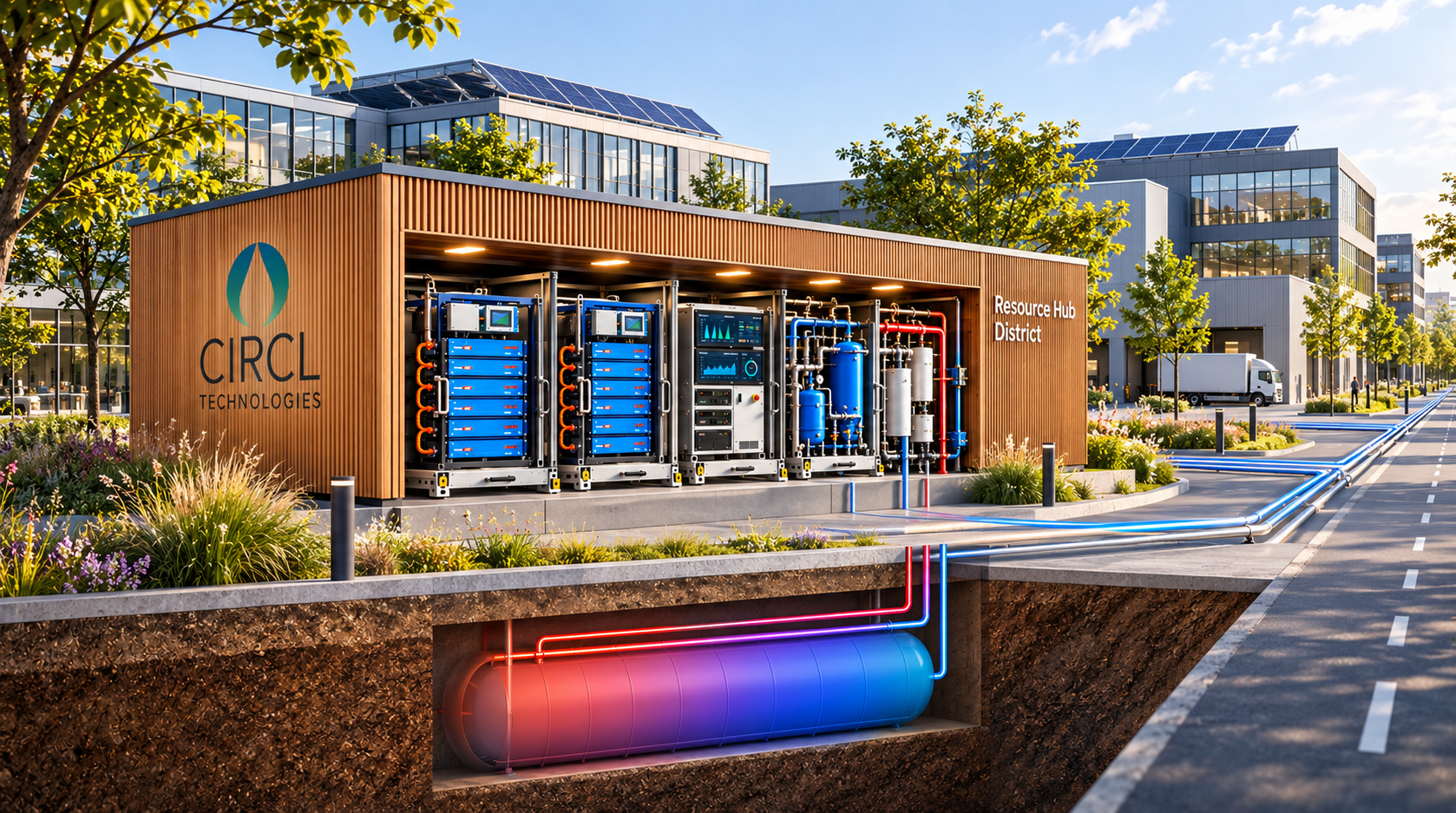
The Resource Hub is a modular, technology-agnostic infrastructure concept: select the technologies the project needs, integrate them through defined interfaces and enable future adaptation without redesigning the entire system.
One technology foundation
Two environments. One adaptable Resource Hub.
Start with physical energy and water infrastructure. Add collective operational services only where the business case calls for them.
Urban districts
Integrated resources for connected neighbourhoods.
Support new neighbourhoods and mixed-use districts through local generation, electrical and thermal storage, water treatment, water reuse and smart distribution to individual buildings and points of use.
Energy and water integration at district scale
Prefabricated building connections with ERA, where appropriate
Phased, technology-agnostic modular expansion
Business parks
Shared capacity for productive growth.
Use the same modular infrastructure to manage local generation, shared storage and flexible loads. Where commercially and technically suitable, Circl can coordinate collective grid capacity, capacity agreements and optional energy market services.
Peak management and smarter use of existing grid space
GTO feasibility, coordination and operational management
Optional CSP, trading and settlement services
Business park services
More than hardware. Optional collective energy operations.
For business parks, Circl can provide additional services on top of the Resource Hub, subject to contract arrangements, regulatory requirements and project feasibility.
01
Group Transport Agreement (GTO)
Assess the feasibility of a shared transport agreement and support the participant group with coordination, capacity allocation rules and operational implementation. The GTO is agreed with the grid operator by the duly authorised group representative.
02
Collective capacity management
Monitor group-wide demand, forecast peaks and control designated flexible assets to operate within agreed import and export limits, with local safety controls.
03
Energy trading & settlement platform
Provide measurement, internal allocation, reporting and settlement workflows. Actual energy supply and market transactions require separate arrangements with appropriately authorised market parties.
04
Optional CSP services
Support congestion management and flexibility offerings through Circl once appropriately recognised, or through an accredited congestion service provider partner.
05
Managed EMS operations
Circl develops and operates the energy management and capacity platform, coordinating local generation, storage and flexible demand.
06
Asset intelligence
Circl Impact Data can connect meters, equipment and maintenance systems to provide monitoring, reporting and lifecycle insights.
A GTO is a shared electricity transport agreement, not automatically a licence to sell or trade electricity. Collective transport arrangements, CSP participation and market settlement each require their own appropriate contractual and technical setup.
Why Circl
Six reasons to build differently.
Benefits are tailored to the operating requirements and infrastructure of each project.
01
Shared resource optimisation
Coordinate local generation, storage and appropriate water reuse across multiple buildings, facilities or businesses.
02
Reduced network pressure
Use local resources, storage and intelligent dispatch to manage demand peaks and reduce reliance on central networks.
03
Flexible, modular expansion
Add, replace or reconfigure technology skids as the district grows and requirements change.
04
Integrated infrastructure economics
Explore shared infrastructure and lifecycle value while avoiding unnecessary duplication of equipment.
05
Prefab-ready building connections
ERA prefab installation modules can connect distributed buildings and points of use to circular systems.
06
Optional collective energy services
For suitable business parks, add GTO support, shared capacity control, transaction settlement and CSP services through an accredited role or partner.
Solution architecture
Build the infrastructure. Add the services.
A technology-first stack supports projects of different sizes and operational complexity.
OPTIONAL: Business Park Energy ServicesGTO support · Capacity management · Trading & settlement · CSP/flexibility
↕
Circl Energy & Water ManagementLocal EMS · Monitoring · Data integrations · Optimisation
Connected buildings, businesses and infrastructureConsumption · Production · Flexible loads · Prefab distribution where relevant
Technical architecture
Technology that works together.
Core technology for both applications; the business park can add an optional collective energy management and market services layer.
Conceptual technology setup · Districts & Business Parks
Illustrative engineering concept — final interfaces and requirements are project-specific.
Distributed generationRoof- and façade-integrated solar across buildings and shared sites.
Shared storageElectrical and thermal storage sized to collective demand and continuity requirements.
District water infrastructureCapture, treatment, buffering and safe non-potable reuse where permitted.
Local energy & water networksDesigned distribution and metering between central and decentral facilities.
Smart district & park controlsDemand forecasting, dispatch, group limit monitoring and reporting, where applicable.
Prefabricated connectionsWith ERA Prefab Systems, repeatable distribution skids to connect building-level uses where appropriate.
Modular infrastructure
Replace a technology. Not the entire system.
The skid-based approach is designed around modular components and defined integration points. It enables technology upgrades and maintenance interventions while supporting the longer-term use of the surrounding infrastructure.
Technology-agnostic selection of suitable components
Skid-based modules that can be maintained and replaced
System-level monitoring and intelligent operation
Engineering based on lifecycle performance
Illustrative Resource Hub configuration
Applications
Where this solution fits.
↗
New urban districts
↗
Mixed-use city quarters
↗
Urban regeneration
↗
Business parks & campuses
For business parks, shared transport capacity requires a suitable GTO agreement and group governance; energy trading and CSP services are separate optional arrangements. All solutions remain subject to technical and regulatory feasibility.
Start a conversation
Discuss your district or business park project.
Explore the suitable Resource Hub configuration, technical requirements and commercial possibilities with Circl Technologies.